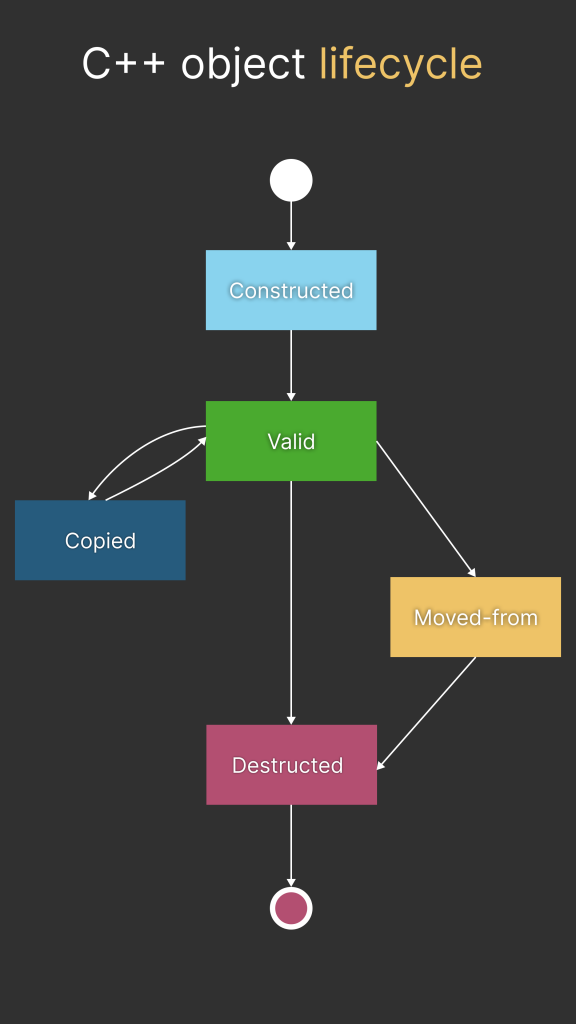
Most C++ bugs do not come from missing modern language features.
They come from misunderstanding core concepts — especially object lifetime.
This free guide explains how object lifetime works in C++: what constructors and destructors are really responsible for, how copy and move operations differ, and when the Rule of Five actually matters.
You’ll also receive a short monthly email with practical C++ and CMake insights — no spam, no noise, no fluff. Just things that help you build better software.
What you get when you subscribe
🎁 Instant access
Free PDF: C++ Object Lifetime: A Practical Guide
A concise, example-driven guide explaining how object lifetime works in C++:
what constructors and destructors are really responsible for, how copy and move operations differ, and when the Rule of Five matters in real code.
📬 Monthly newsletter
- One email per month
- Practical C++ and CMake topics
- Real-world patterns, not theory
- No marketing emails, no sales funnels
What’s inside the free C++ Object Lifetime guide
- Constructors define invariants
A well-designed constructor must leave the object fully initialized.
If your type can exist in a “half-ready” state, bugs are inevitable. - Copy vs move semantics
Copying duplicates ownership.
Moving transfers it and leaves the source in a valid-but-unspecified state.
Using an object incorrectly after a move is a common source of subtle bugs. - Special member functions and ownership
If a class manages a resource, default copy/move/destruction may be wrong.
This is where RAII and the Rule of Five come into play.
This newsletter is for
- C++ developers who want a stronger grasp of object lifetime and ownership
- Engineers working with copy/move semantics, RAII, and class design
- Developers who want fewer subtle lifetime bugs and clearer invariants
- Anyone who wants to understand C++ more deeply instead of memorizing isolated tricks
C++ code don’t have to be fragile.
Destructors should release owned resources — not perform unrelated cleanup logic.
Get instant access to the guide
One focused email per month.
No spam. No noise. Unsubscribe anytime.
To complete your subscription:
- Open the confirmation email we just sent.
- Click Confirm to receive your PDF right away.
If the message doesn’t show up, please check Spam/Promotions.
That’s it.
A clean PDF with practical examples — plus one useful email per month to help you build better C++ software.