FREE PRACTICAL C++ GUIDE
Lambdas are everywhere in modern C++.
But understanding the syntax is only the beginning.
This guide explains what a lambda actually becomes after compilation, how captures affect ownership and lifetime, how stateful lambdas work, and where lambdas fit into STL algorithms, callbacks, and real application code.
A Lambda Is More Than Shorter Syntax
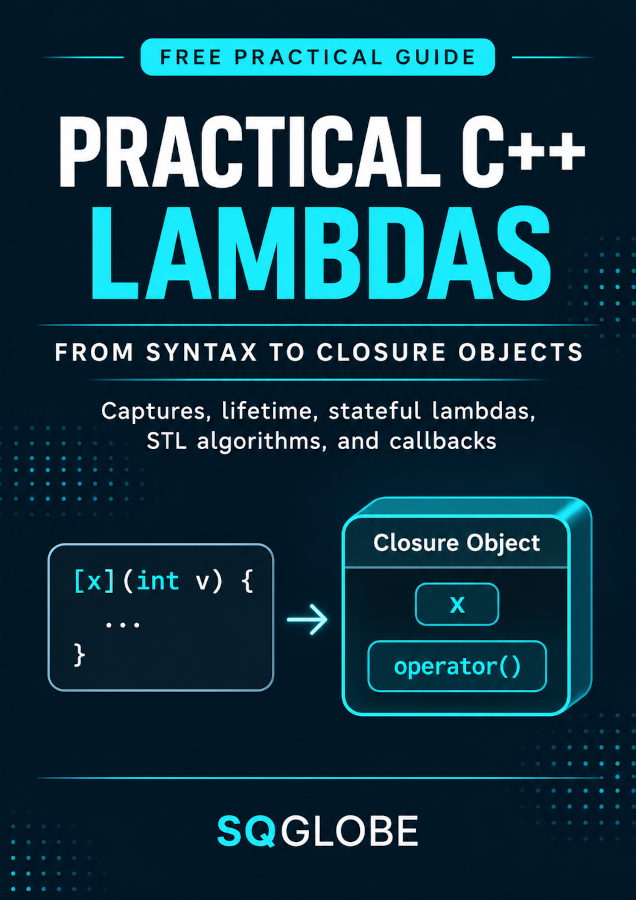
A lambda expression creates an object of a unique compiler-generated closure type.
Its operator() defines the callable behavior, while captured values become part of the object’s state.
Once you understand that model, many lambda features become much easier to reason about:
- why value and reference captures behave differently;
- why a lambda can keep state between calls;
- why some lambdas can outlive their surrounding scope;
- why capturing by reference can create dangling references;
- why captureless lambdas can work with C-style callbacks;
- and when a named callable type is still the clearer design.
What You’ll Learn
What a Lambda Actually Is
Build a practical mental model of the compiler-generated closure object and understand how operator() represents the callable behavior.
Capture by Value vs. Reference
Learn when a lambda should own the values it needs and when referencing existing state is appropriate.
Lambda Lifetime and Dangling References
Understand why reference captures do not extend object lifetime and how stored callbacks, returned lambdas, and asynchronous work can become dangerous.
Mutable and Stateful Lambdas
See how captured state can live inside a closure object and how mutable changes the generated call operator.
Lambdas with STL Algorithms and Callbacks
Use lambdas where they are most useful: predicates, transformations, local strategies, event handlers, and callback APIs.
Modern Lambda Features
See how lambdas evolved from C++11 through newer standards, including generic lambdas, init-capture, constexpr, template parameter lists, constraints, and C++23 features.
Captures Are Ownership Decisions
Consider these two lambdas:
[name](const Foo& foo) {
    return foo.name() == name;
}
and:
[&name](const Foo& foo) {
    return foo.name() == name;
}
They may look almost identical.
But they have very different lifetime semantics.
A value capture stores its own value inside the closure object.
A reference capture refers to an object owned somewhere else.
That distinction becomes especially important when the lambda is returned, stored as a callback, or executed asynchronously.
The practical rule is simple:
Think about lifetime and ownership first. Performance comes second.
Where Lambdas Fit Best
Lambdas work particularly well for small pieces of behavior that are meaningful only near the call site.
Typical examples include:
- STL predicates and transformations;
- callbacks stored in
std::function; - custom deleters;
- work passed to threads;
- event handlers;
- short local strategies.
But not every callable needs to be a lambda.
If behavior is reused, represents a meaningful abstraction, or deserves a stable name of its own, a named function or callable type may still be the better choice.
Understand What Your Lambda Really Stores
Lambda syntax is compact.
The object behind that syntax is not magic.
Once captures, closure state, lifetime, and operator() are clear, lambdas become much easier to use safely and deliberately.
Get the complete guide and build a practical mental model for modern C++ lambdas.