Get a free 10–15 page PDF guide explaining one of the most misunderstood C++ fundamentals:
- constructors and invariants
- copy vs move semantics
- destructors, RAII, and the Rule of Five
Clear explanations, real examples, and diagrams.
The guide also includes a subscription to From Complexity to Essence in C++ — one practical C++ or CMake deep dive per month.
No spam. Unsubscribe anytime.
By entering your email and confirming your subscription, you’ll receive the free PDF guide and subscribe to From Complexity to Essence in C++.
One focused email per month. Unsubscribe anytime.
What happens next
- Enter your email
- Confirm your subscription
- Get the PDF immediately
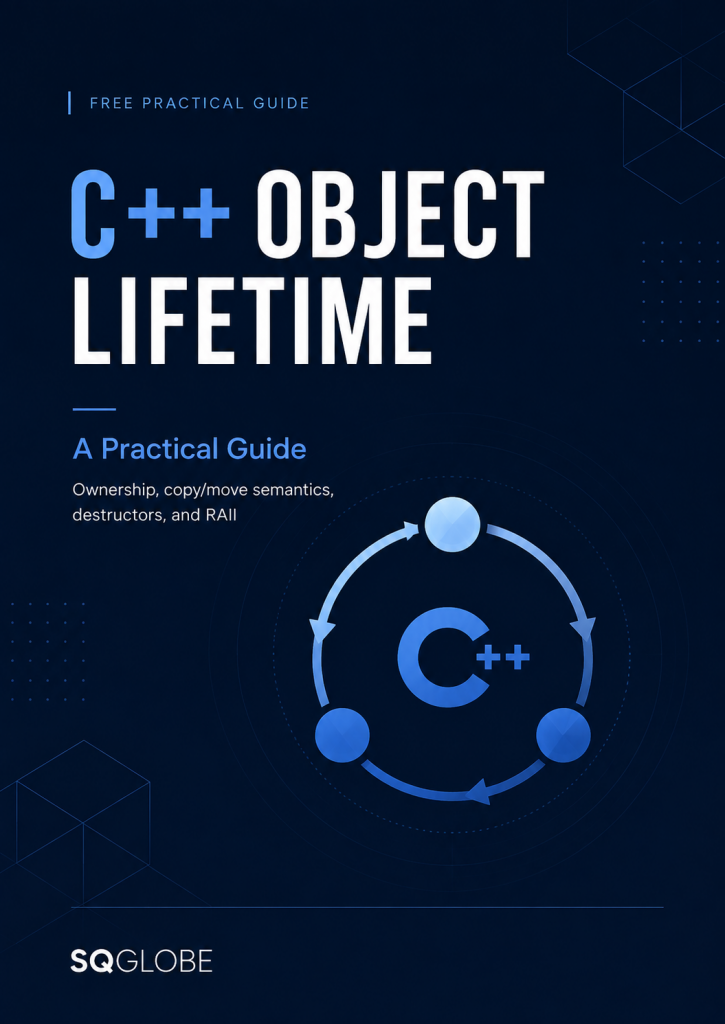
What’s inside the free guide to C++ object lifetime and special member functions
- Constructors define invariants
Why a type must be fully usable right after construction. - Copy vs move semantics
What ownership duplication and ownership transfer really mean. - Special member functions and ownership
When compiler-generated defaults are enough — and when they become dangerous. - Destructors and RAII
Why cleanup belongs to resource-owning types, not everywhere.
From Complexity to Essence in C++ is for
- C++ developers who want a stronger grasp of object lifetime and ownership
- Engineers working with copy/move semantics, RAII, and class design
- Developers who want fewer subtle lifetime bugs and clearer invariants
- Anyone who wants to understand C++ more deeply instead of memorizing isolated tricks
This is more than a one-off PDF
You’ll also receive one focused monthly email with practical C++ and CMake deep dives.
No noise. No “clean code” slogans.
Just clear explanations, real trade-offs, and production-oriented thinking.
Build a stronger mental model of C++
Start with object lifetime — one of the foundations behind safer, more maintainable code.
Confirm your email to receive the PDF right away.